Japan leads global fermented food consumption
- #USanctions
- #KajaKallas
- #UkraineRussiaWar
- #BrazilianTennis
- #RolandGarros
- #JoaoFonseca
- #BringThemBack
- #SchoolKidnappings
- #NigeriaEducation
- #GenocideMemorial
- #PaulKagame
- #FranceRwanda
- #Donetsk
- #terrorist
- #Ukrainian
- #Islamic Revolutionary Guard Corps
- #Strait of Hormuz
- #MiddleEastPolitics
- #IsraelLebanon
- #MarcoRubio
- #Visualized
- #World Visualized
- #USanctions
- #KajaKallas
- #UkraineRussiaWar
- #BrazilianTennis
- #RolandGarros
- #JoaoFonseca
- #BringThemBack
- #SchoolKidnappings
- #NigeriaEducation
- #GenocideMemorial
- #PaulKagame
- #FranceRwanda
- #Donetsk
- #terrorist
- #Ukrainian
- #Islamic Revolutionary Guard Corps
- #Strait of Hormuz
- #MiddleEastPolitics
- #IsraelLebanon
- #MarcoRubio
- #Visualized
- #World Visualized
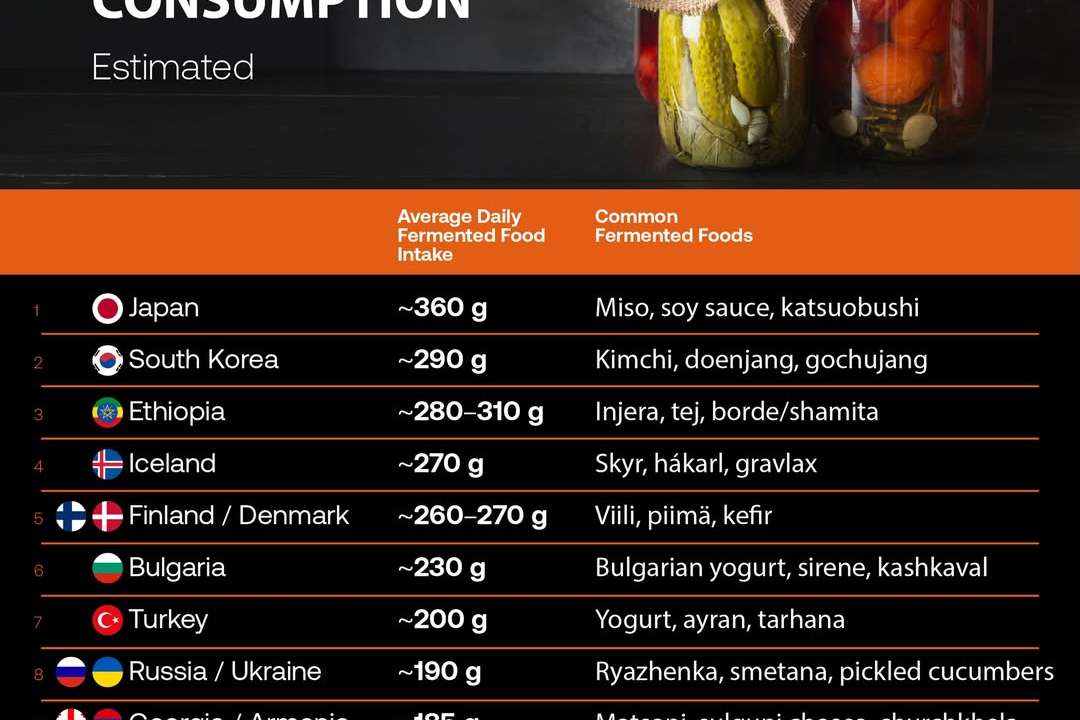
Japan tops the world in estimated daily per-capita fermented food consumption, highlighting the enduring role of traditional diets in modern nutrition as scientists continue to explore the health benefits of fermented foods.
Main Points
- Japan leads globally with an estimated 360 grams of fermented foods consumed per person daily.
- South Korea and Ethiopia follow closely, supported by traditional staples such as kimchi and injera.
- Scientific research increasingly links fermented foods to gut health, microbiome diversity and reduced inflammation.
Japan tops the world in estimated daily per-capita fermented food consumption, highlighting the enduring role of traditional diets in modern nutrition as scientists continue to explore the health benefits of fermented foods.
According to data compiled from Fermented Food Consumption Analysis, Public Health Nutrition (2024), PubMed Central, and other academic sources, the average person in Japan consumes approximately 360 grams of fermented foods daily, placing the country ahead of South Korea, Ethiopia and several Nordic nations.
Japan's leadership reflects the widespread use of fermented ingredients in everyday meals. Common staples include miso, soy sauce and katsuobushi, all of which are produced through fermentation processes that have been refined over generations.
South Korea ranks second with an estimated 290 grams per person daily, driven largely by the country's famous fermented dishes such as kimchi, doenjang and gochujang. Kimchi alone is consumed regularly by a majority of South Korean households and is widely regarded as a cornerstone of the national diet.
Indonesia rounds out Asia's representation in the top ten with approximately 175 grams per day, supported by traditional foods including tempeh, tape and oncom.
Outside Asia, Ethiopia stands out with an estimated daily consumption of 280–310 grams, reflecting the importance of fermented staples such as injera, the country's iconic sourdough flatbread, as well as traditional fermented beverages including tej and borde.
Northern Europe also performs strongly. Iceland ranks fourth at around 270 grams per day, while Finland and Denmark share fifth place with 260–270 grams daily.
In these countries, fermented dairy products play a central role. Foods such as skyr, viili, piimä and kefir have been consumed for centuries and remain popular components of everyday diets.
Bulgaria, Turkey, Russia, Ukraine, Georgia and Armenia all feature prominently in the ranking, reflecting the region's longstanding relationship with fermented milk products and preserved foods.
Bulgaria records approximately 230 grams daily, supported by its globally recognised yoghurt culture. Turkey follows with around 200 grams, where yoghurt, ayran and tarhana continue to be dietary staples.
Meanwhile, Russia and Ukraine average about 190 grams, with foods such as ryazhenka, smetana and pickled vegetables remaining common household items.
Growing consumer interest in gut health has brought renewed attention to fermented foods. Research published in journals including Public Health Nutrition and studies indexed by PubMed Central suggest that fermented foods may contribute beneficial microorganisms and bioactive compounds that support digestive health and microbial diversity.
A widely cited Stanford University study found that diets rich in fermented foods were associated with increased microbiome diversity and reduced markers of inflammation in healthy adults.
Researchers caution, however, that the health impact of fermented foods can vary depending on the type of food, preparation methods and overall dietary patterns.
This story is written and edited by the Global South World team, you can contact us here.