Most Indians have never travelled abroad, Pew Research data shows
- #MiddleEastPolitics
- #IsraelLebanon
- #MarcoRubio
- #IndonesianCulture
- #WestSumatra
- #PacuJawi
- #loan programme
- #European Union
- #European Commission
- #Luhansk region
- #drone strike
- #political transition
- #constitutional changes
- #Tamas Sulyok
- #Peter Magyar
- #DemocracyInAction
- #TayeAtskeSelassie
- #EthiopiaElection
- #LebanonNews
- #IsraelHezbollahConflict
- #Visualized
- #World Visualized
- #MiddleEastPolitics
- #IsraelLebanon
- #MarcoRubio
- #IndonesianCulture
- #WestSumatra
- #PacuJawi
- #loan programme
- #European Union
- #European Commission
- #Luhansk region
- #drone strike
- #political transition
- #constitutional changes
- #Tamas Sulyok
- #Peter Magyar
- #DemocracyInAction
- #TayeAtskeSelassie
- #EthiopiaElection
- #LebanonNews
- #IsraelHezbollahConflict
- #Visualized
- #World Visualized
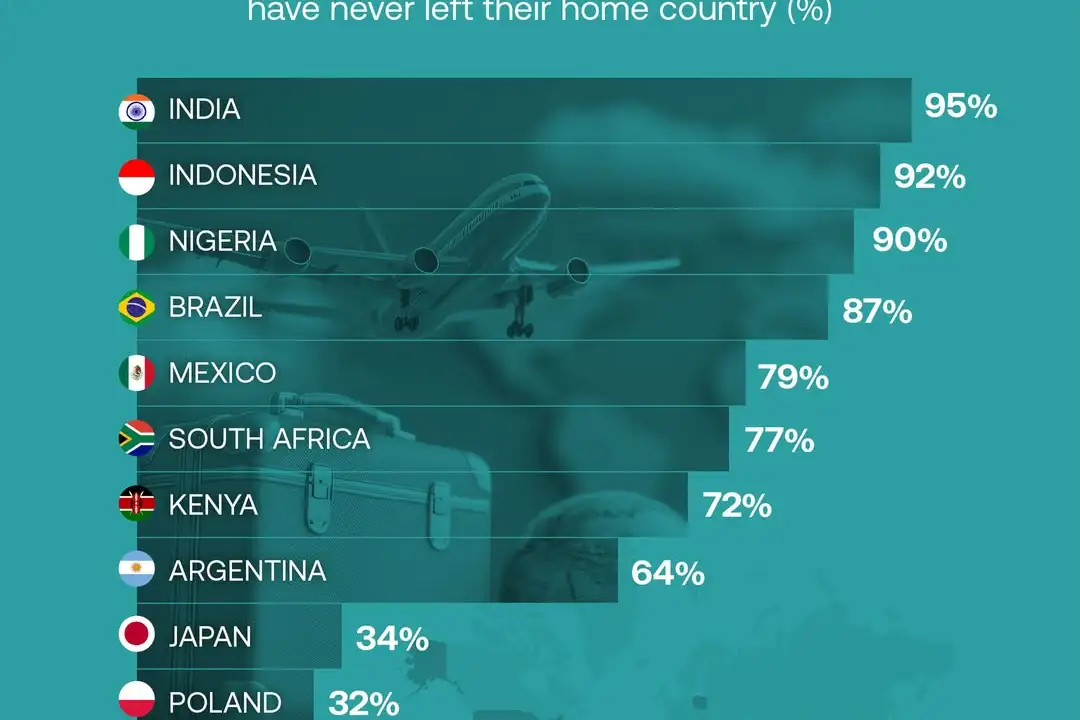
International travel remains out of reach for much of the world's population, with new data highlighting significant differences in overseas travel experience across major economies.
Key Points
- India tops the ranking, with 95% of respondents saying they have never travelled outside the country.
- Developing economies dominate the list, including Indonesia, Nigeria, Brazil and Mexico, where international travel remains less common.
- Income, passport ownership and visa restrictions are among the main factors shaping global travel opportunities.
International travel remains out of reach for much of the world's population, with new data highlighting significant differences in overseas travel experience across major economies.
According to findings from the Pew Research Centre, India ranks among the countries with the highest share of people who have never left their home country, with 95% of respondents reporting they had never travelled abroad. Indonesia followed at 92%, while Nigeria stood at 90%.
The survey shows that large developing nations account for many of the highest percentages of citizens who have never crossed an international border.
After India, Indonesia and Nigeria, the ranking includes Brazil (87%), Mexico (79%), South Africa (77%), Kenya (72%) and Argentina (64%).
By contrast, wealthier countries reported substantially lower figures. In Japan, 34% of respondents said they had never travelled abroad, compared with 32% in Poland and 23% in the United States.
Researchers note that population size can play a major role. Countries such as India, Brazil and the United States offer vast domestic travel opportunities, reducing the necessity of international trips for many citizens.
Pew Research has consistently found that income levels strongly influence overseas travel patterns. International travel often requires significant spending on transportation, accommodation, visas and travel documents, making it less accessible for lower-income households.
Passport ownership also varies widely between countries. Government data show that only a minority of citizens in many developing nations hold valid passports, limiting opportunities for international travel even when interest exists.
In addition, visa restrictions continue to affect mobility. Citizens of some countries face more stringent entry requirements, higher application costs and longer approval processes than travellers from wealthier nations.
Experts say high percentages of citizens who have never travelled abroad do not necessarily indicate a lack of travel culture.
In countries with large territories and diverse landscapes, domestic tourism frequently serves as an alternative. India, for example, attracts hundreds of millions of domestic tourist visits annually, while Brazil, Mexico and the United States maintain extensive internal tourism markets.
Geography can also influence travel habits. Residents of smaller European countries often cross borders regularly for work, leisure or education, contributing to higher rates of international travel experience.
Despite the disparities, international tourism has grown significantly over recent decades. According to the UN World Tourism Organisation (UN Tourism), global travel has recovered strongly following the pandemic-era downturn, with international arrivals approaching or surpassing pre-2020 levels in many regions.