Strong earthquakes rattle multiple regions in 12 hours
- #gender-based violence
- #Cadastro Nacional de Agressores
- #violence against women
- #femicide
- #flood contingency plan
- #Ghana Meteorological Agency
- #urban drainage
- #US-brokered agreement
- #Hezbollah disarmament
- #Israel Katz
- #Edgar Snow
- #rural development
- #Communist Party
- #Flávio Bolsonaro
- #re-election campaign
- #national defence
- #AntiDrugOperation
- #GiorgiaMeloni
- #international assistance
- #La Guaira
- #Visualized
- #World Visualized
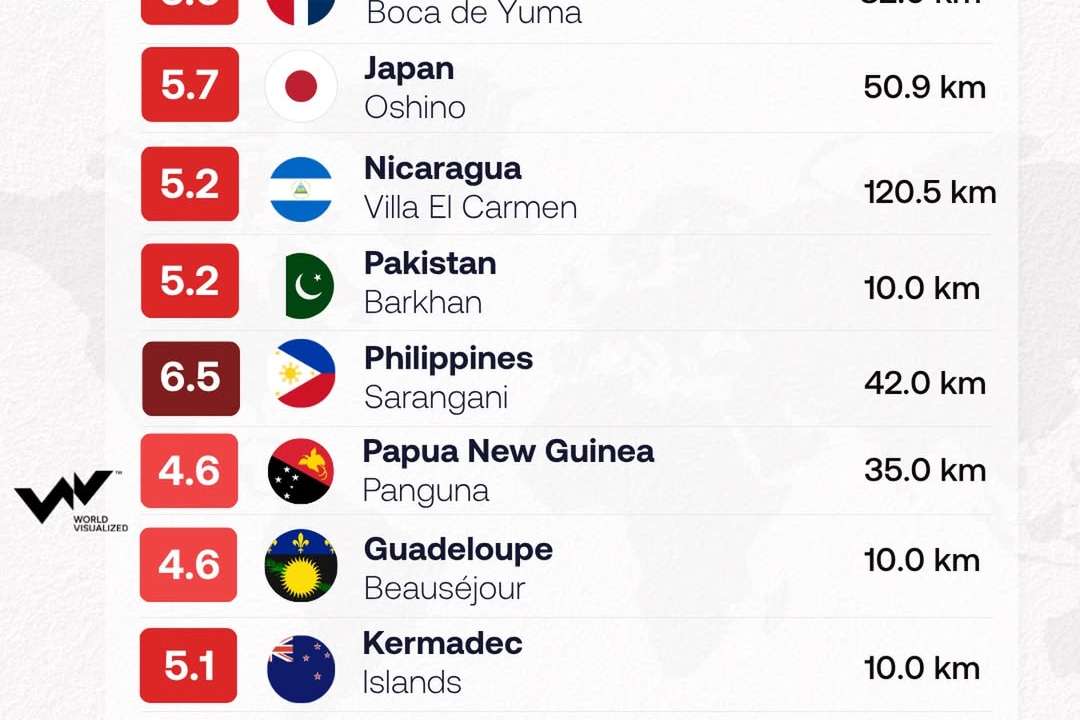
A series of strong earthquakes struck multiple regions across the globe within 12 hours, with the strongest a magnitude 6.5 earthquake off the coast of the southern Philippines.
Main Points
- Philippines recorded the strongest earthquake at magnitude 6.5
- Japan experienced two earthquakes above magnitude 5
- Eleven earthquakes above magnitude 4.5 struck in 12 hours
A series of strong earthquakes struck multiple regions across the globe within 12 hours, with the strongest a magnitude 6.5 earthquake off the coast of the southern Philippines.
The USGS recorded 11 earthquakes of magnitude 4.5 or higher during the period, affecting countries across Asia, Oceania, Central America and the Caribbean. The events ranged from magnitude 4.6 to 6.5, highlighting the concentration of seismic activity along the Pacific "Ring of Fire," where tectonic plates frequently interact.
The largest event was a magnitude 6.5 earthquake that struck 34 kilometres west-southwest of Sarangani, Philippines, at a depth of 42 kilometres.
The quake occurred in a region that is among the world's most seismically active due to the interaction of the Philippine Sea Plate and the Eurasian Plate. The USGS assigned the event a Green PAGER alert, indicating that widespread fatalities or major economic losses were unlikely.
RECOMMENDED FOR YOU

NVIDIA’s AI boom sends data-centre revenue above $75 billion
The tremor came less than three weeks after a devastating magnitude 7.8 earthquake struck southern Mindanao on June 8, underscoring the region's continued seismic activity.
Japan recorded two earthquakes exceeding magnitude 5 during the same period.
A magnitude 5.8 earthquake struck near Yokoshiba at a depth of 43 kilometres, followed later by a magnitude 5.7 event near Oshino at 50.9 kilometres depth, according to the USGS.
Japan sits atop the convergence of four major tectonic plates and experiences thousands of earthquakes each year, making it one of the world's most earthquake-prone countries.
Elsewhere, the USGS recorded:
- Magnitude 5.2 near Villa El Carmen, Nicaragua (120.5 km depth)
- Magnitude 5.2 and 4.7 near Barkhan, Pakistan (10 km depth)
- Magnitude 5.1 south of the Kermadec Islands
- Magnitude 5.0 south of Boca de Yuma, Dominican Republic
- Magnitude 4.9 near Nikolski, Alaska
- Magnitude 4.6 near Panguna, Papua New Guinea
- Magnitude 4.6 east of Beauséjour, Guadeloupe
Most of these earthquakes occurred along active plate boundaries, particularly around the Pacific Ring of Fire, a horseshoe-shaped belt that accounts for roughly 90% of the world's earthquakes and about 75% of active volcanoes, according to the USGS.
Why earthquakes cluster along the Ring of Fire
The Ring of Fire stretches around the Pacific Ocean through the Americas, East Asia and Oceania. Continuous movement of tectonic plates causes frequent earthquakes as plates collide, separate or slide past one another.
Countries such as Japan, the Philippines, Papua New Guinea and New Zealand routinely experience significant seismic activity because they lie directly on these plate boundaries.
RECOMMENDED FOR YOU

China's media is the most trusted around the world