World's highest settlements above the clouds
Life at extreme altitude is not limited to remote mountain villages. Some of the world's highest permanent settlements are home to hundreds of thousands, and in some cases more than a million people, who have adapted to thin air, freezing nights and reduced oxygen levels.
Main Points
- La Rinconada is the world's highest settlement
- Bolivia is home to three of the highest cities
- High-altitude populations evolved unique adaptations
Life at extreme altitude is not limited to remote mountain villages. Some of the world's highest permanent settlements are home to hundreds of thousands, and in some cases more than a million people, who have adapted to thin air, freezing nights and reduced oxygen levels.
Leading the list is La Rinconada in southeastern Peru, the world's highest permanent settlement at approximately 5,100 metres (16,732 feet) above sea level. Located near the Ananea gold mines in the Andes, the town grew rapidly because of informal gold mining despite lacking many basic public services. Encyclopaedia Britannica and scientific studies describe it as one of the harshest places on Earth to live, where oxygen levels are roughly half those at sea level.
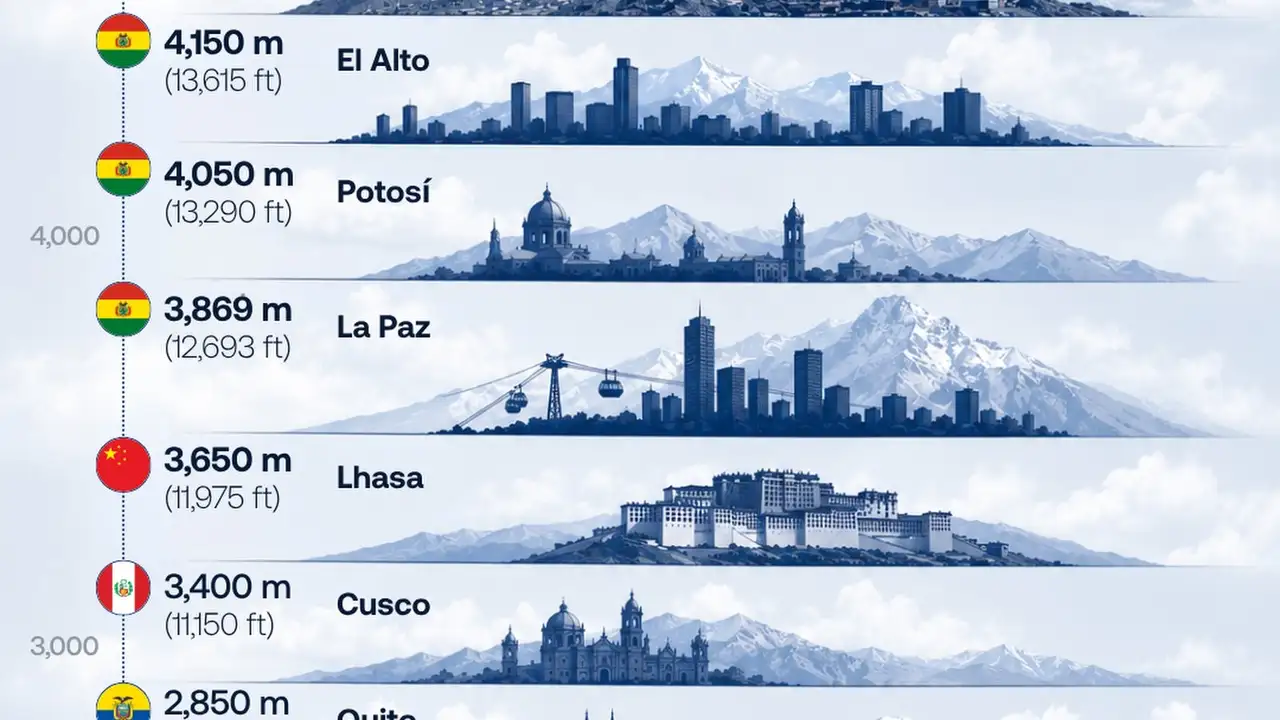
Bolivia is home to three of the ten highest settlements on the list.
El Alto, at around 4,150 metres, is the world's highest major city and one of Bolivia's fastest-growing urban centres. According to Encyclopaedia Britannica, it has grown into an economic hub linked directly to neighbouring La Paz through highways and one of the world's highest urban cable car systems.
Nearby Potosí, sitting at about 4,050 metres, was once among the richest cities in the world after vast silver deposits were discovered at Cerro Rico in the 16th century. During the Spanish Empire, its mines supplied enormous quantities of silver that helped finance Spain's global ambitions.
Although often regarded as Bolivia's capital, La Paz is the country's administrative capital and lies at around 3,650 to 3,870 metres, depending on the district. Government offices are located there, while Sucre remains Bolivia's constitutional capital.
Living above 2,500 metres presents significant physiological challenges. The World Economic Forum notes that lower oxygen levels reduce physical performance for newcomers, while long-term residents often develop genetic and biological adaptations that improve oxygen transport.
Research published in scientific journals and summarised by IFLScience shows that populations in the Andes, Tibetan Plateau and Ethiopian Highlands have evolved different adaptations over thousands of years. Tibetans, for example, have genetic traits that allow more efficient oxygen use without producing excessive red blood cells, while many Andean populations tend to have higher haemoglobin concentrations.
China's Lhasa, standing at approximately 3,650 metres, is the historic capital of Tibet and home to the Potala Palace, a UNESCO World Heritage Site that served for centuries as the residence of the Dalai Lamas.
Peru's Cusco, at roughly 3,400 metres, was the capital of the Inca Empire before the arrival of the Spanish and remains one of South America's most important historical cities.
Further north, Quito in Ecuador sits at around 2,850 metres on the slopes of the Andes. Its historic centre is one of the best-preserved colonial districts in Latin America and was among the first sites inscribed on UNESCO's World Heritage List in 1978.
Bogotá, Colombia's capital, stands at approximately 2,640 metres, while Addis Ababa, Ethiopia's capital, sits at around 2,450 metres and is often described as Africa's highest capital city. Asmara, the capital of Eritrea at 2,325 metres, is recognised by UNESCO for its exceptionally preserved Italian modernist architecture.
This story is written and edited by the Global South World team, you can contact us here.