2025 RECAP: Where gaps widened — and bonds formed — in the Global South
Where cracks widened in 2025, bonds also tightened.
Across the Global South, Western sanctions — particularly those imposed by the United States — pushed countries once considered loosely aligned, or even at odds, toward deeper coordination.
What began as tactical responses to pressure increasingly took institutional form, as blocs such as BRICS+ and the Shanghai Cooperation Organisation (SCO) moved beyond political signalling to more structured cooperation.
US sanctions and rising non-Western alliances emerged as defining forces this year.
US pressure
One of the year’s most visible sanctions flashpoints remained Venezuela. After limited relief in earlier years, the US reimposed tighter restrictions on Caracas’s oil sector as negotiations over political reforms stalled.
The measures complicated crude exports by targeting licensing, shipping and insurance channels, further constraining one of Venezuela’s few remaining sources of hard currency. Authorities in Caracas accused Washington of economic coercion, while Russia and China reiterated diplomatic support and criticised the use of unilateral sanctions.
Global South World tracked the standoff closely throughout the year, including an exclusive interview with Rollie Flynn, chief executive of the Arkin Group and a former CIA officer, who warned that the confrontation carried risks beyond counter-narcotics work.
With Western sanctions on Russia still in place and restrictions on Iran largely intact, 2025 underscored a wider reality: energy producers operating outside the US-led system increasingly faced fragmented trade rules, rerouted supply chains and parallel payment arrangements.
For oil-importing developing economies, the impact was indirect but tangible, adding volatility to prices and procurement even when they were not direct targets.
BRICS+ rising
Against this backdrop, non-Western groupings sought to tighten coordination.
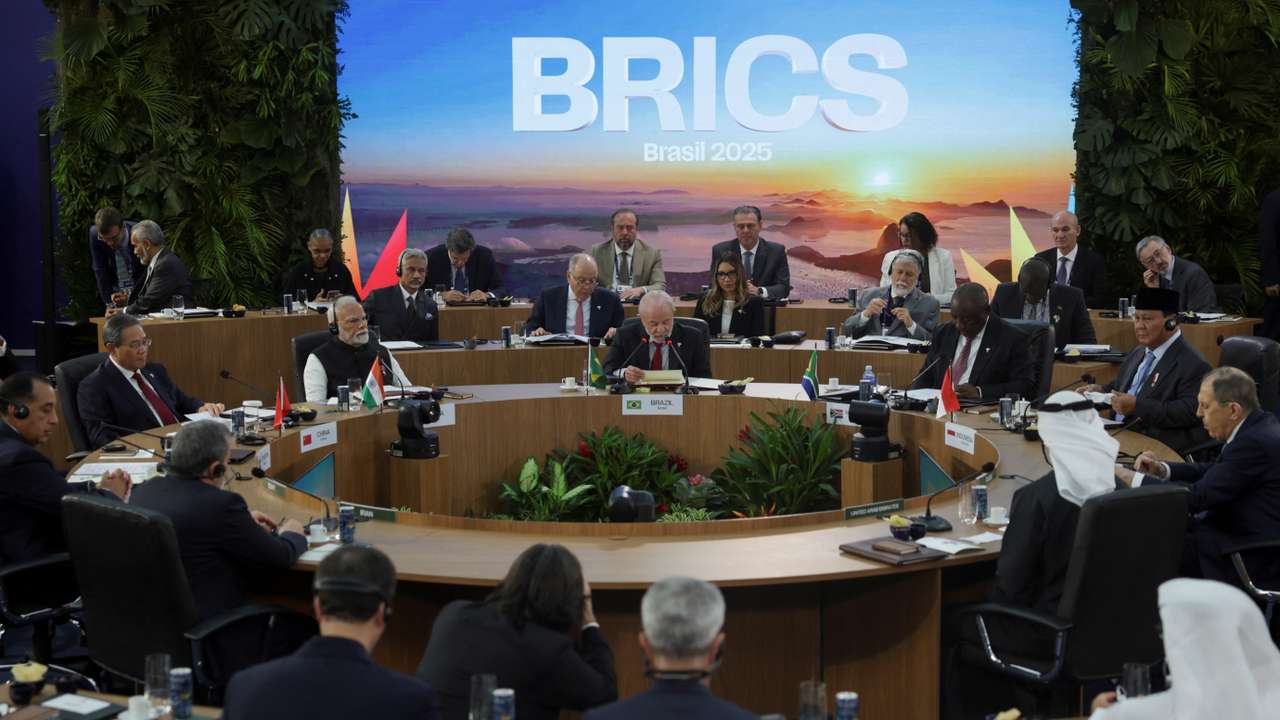
At the BRICS summit in Rio de Janeiro in July, leaders of the expanded bloc reaffirmed cooperation on development finance, trade and global governance reform.
While the group stopped short of unveiling a common currency or alternative payment system, the summit reinforced political alignment among members that now include major energy exporters in the Middle East and Africa — significantly expanding BRICS’ economic weight and diplomatic reach.
In response, US President Donald Trump warned that countries aligning with what he described as BRICS’ “anti-American policies” could face additional tariffs, a statement that underscored how sanctions and trade pressure have become increasingly intertwined.
SCO hardening
Momentum was more institutional at the SCO summit in Tianjin in late August. The organisation adopted a Development Strategy extending to 2035 and approved new permanent centres focused on security threats, transnational crime, information security and narcotics control.
Leaders also signed the Tianjin Declaration, which explicitly opposed unilateral sanctions and protectionism — language widely interpreted as a direct response to US and European coercive measures.
Taken together, the developments highlighted a paradox of US foreign policy under Trump. While sanctions and tariffs were intended to weaken rivals, analysts say they have instead nudged competitors — and even uneasy neighbours — toward closer cooperation.
“This is a strange time when unlikely bedfellows like India and China are now overtly comfortable with each other, which was not the scene until three or four months ago,” said Dr Pooja Bhatt, director of the Jindal School of International Affairs in India, in an interview with Global South World this year.
“This shows how the U.S.’s excessive use of force — through policy and diplomacy — can push even the most unlikely countries to come together,” she said.
All things considered, the Global South does not seem to move toward a complete realignment, but rather toward steady repositioning.
US sanctions remained powerful, particularly for countries dependent on Western finance and technology. At the same time, forums such as BRICS+ and the SCO increasingly offered diplomatic backing, coordination platforms and limited institutional alternatives.
This story is written and edited by the Global South World team, you can contact us here.