Bangladesh's Islamist party open to unity government after February vote
By Ruma Paul and Tora Agarwala
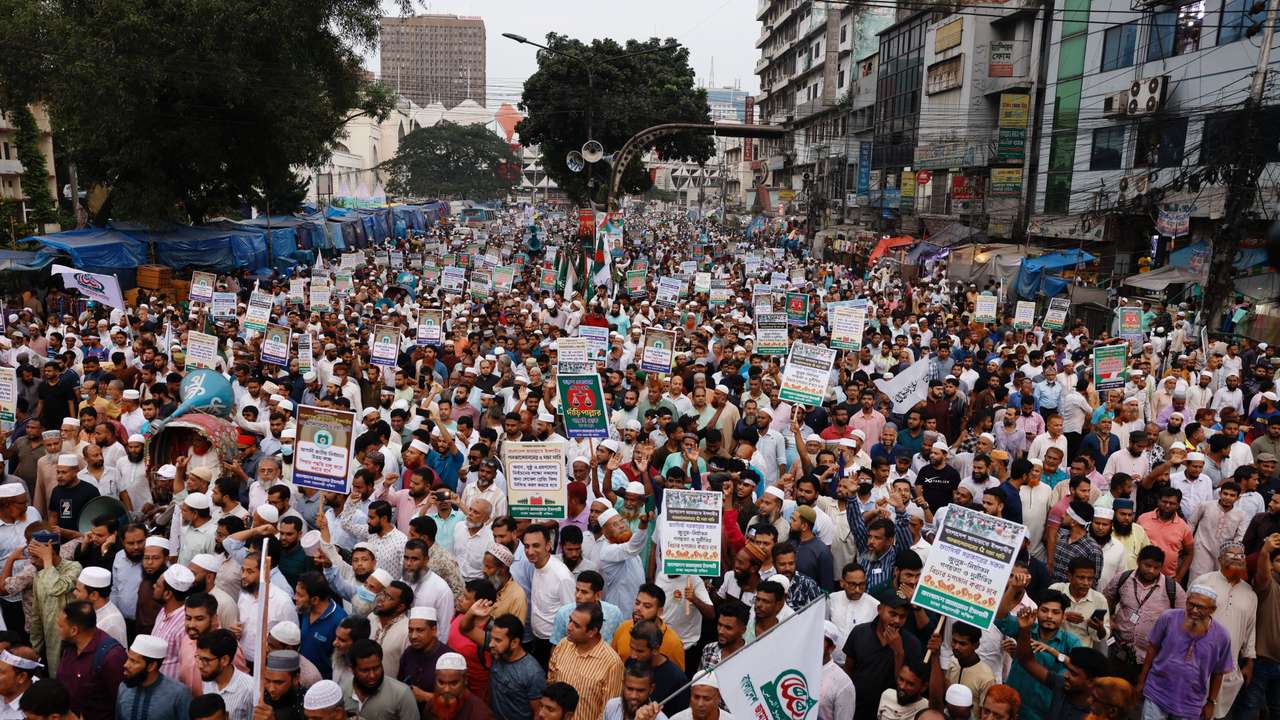
A once-banned Bangladeshi Islamist party, poised for its strongest electoral showing in February's parliamentary vote, is open to joining a unity government and has held talks with several parties, its chief told Reuters on Wednesday.
Opinion polls suggest that Jamaat-e-Islami will finish a close second to the Bangladesh Nationalist Party (BNP) in the first election it has contested in nearly 17 years as it marks a return to mainstream politics in the predominantly Muslim nation of 175 million.
Jamaat last held power between 2001 and 2006 as a junior coalition partner with the BNP and is open to working with it again.
“We want to see a stable nation for at least five years. If the parties come together, we’ll run the government together,” Jamaat Ameer (President) Shafiqur Rahman said in an interview at his office in a residential area in Dhaka, days after the party created a buzz by securing a tie-up with a Gen-Z party.
ANTI-CORRUPTION PLANK
Jamaat advocates Islamic governance under sharia law but has sought to broaden its appeal beyond its conservative base. Rahman said anti-corruption must be a shared agenda for any unity government.
The prime minister will come from the party winning the most seats in the February 12 election, he added. If Jamaat wins the most seats, the party will decide whether he himself would be a candidate, Rahman said.
The party’s resurgence follows the ousting of long-time Prime Minister Sheikh Hasina in a youth-led uprising in August 2024. Hasina, whose Awami League party is now barred from the election, was a fierce critic of Jamaat, and during her tenure, several of its leaders were sentenced to death for alleged war crimes during the 1971 independence conflict with Pakistan, a war Jamaat opposed.
Jamaat had been banned from elections since 2013 after a court ruled its charter violated the country’s secular constitution. An interim government led by Nobel laureate Muhammad Yunus lifted all restrictions on the party in August 2024.
TIES WITH INDIA AND PAKISTAN
Rahman said Hasina’s continued stay in India after fleeing Dhaka was a concern, as ties between the two countries have hit their lowest point in decades since her downfall.
Hindu-majority India, South Asia's biggest power, had cultivated a close working relationship with Hasina, helping expand business and trade ties between the neighbours.
As New Delhi seeks to engage parties that could form the next government, Rahman confirmed meeting an Indian diplomat earlier this year after his bypass surgery. Unlike diplomats from other countries who made open courtesy visits to him, the Indian official asked that the meeting remain confidential, Rahman said.
"Why? There are so many diplomats who visited me and it was made public. Where is the problem?" Rahman said. "So we must become open to all and open to each other. There is no alternative to develop our relationship."
India's foreign ministry did not immediately respond to a request for comment on Rahman's statement about the meeting or any request for it to be confidential.
An Indian government source confirmed contacts with various parties, and India's foreign minister visited Dhaka on Wednesday to offer condolences to the family of BNP chief and former Prime Minister Khaleda Zia, who died on Tuesday.
Asked about Jamaat’s historical closeness to Pakistan, Rahman said: “We maintain relations in a balanced way with all. We are never interested in leaning toward any one country. Rather, we respect all and want balanced relations among nations.”
He said any government that includes Jamaat would "not feel comfortable" with President Mohammed Shahabuddin, who was elected unopposed with the Awami League's backing in 2023.
Shahabuddin, the ceremonial head of the country, himself told Reuters this month that he was willing to step down midway through his term.
Shahabuddin, in a telephone conversation with Reuters on Wednesday, declined to comment on Rahman's position, saying he did not want to "complicate the matter further".
This article was produced by Reuters news agency. It has not been edited by Global South World.