In the Philippines, a history of the US meddling with a dictatorship
Washington’s abrupt and forceful operation in Caracas on Saturday resulted not only in the “capture” of Venezuelan President Nicolas Maduro, but also in widespread concern that the United States has once again engineered a regime change in the Global South.
From the infamous Bay of Pigs invasion against Cuban leader Fidel Castro in the 1960s to Operation Just Cause, which led to the US invasion of Panama in the late 1980s, Washington has a long record of planned — and at times successful — operations aimed at shaping political outcomes in its backyard.
Notably, such interventions have tended to target governments whose leaders the US considers hostile or unreliable.
Yet as the world’s dominant superpower — both economically and militarily — the US has not confined its political interventions to neighbouring states. Its influence has extended far beyond the Americas, reaching countries separated by vast oceans.
Marcos dictatorship in the Philippines
In the Philippines, a Southeast Asian nation more than 8,000 miles from the US, Washington also played a consequential role during a period of authoritarian rule — and later, a limited but pivotal role in its collapse.
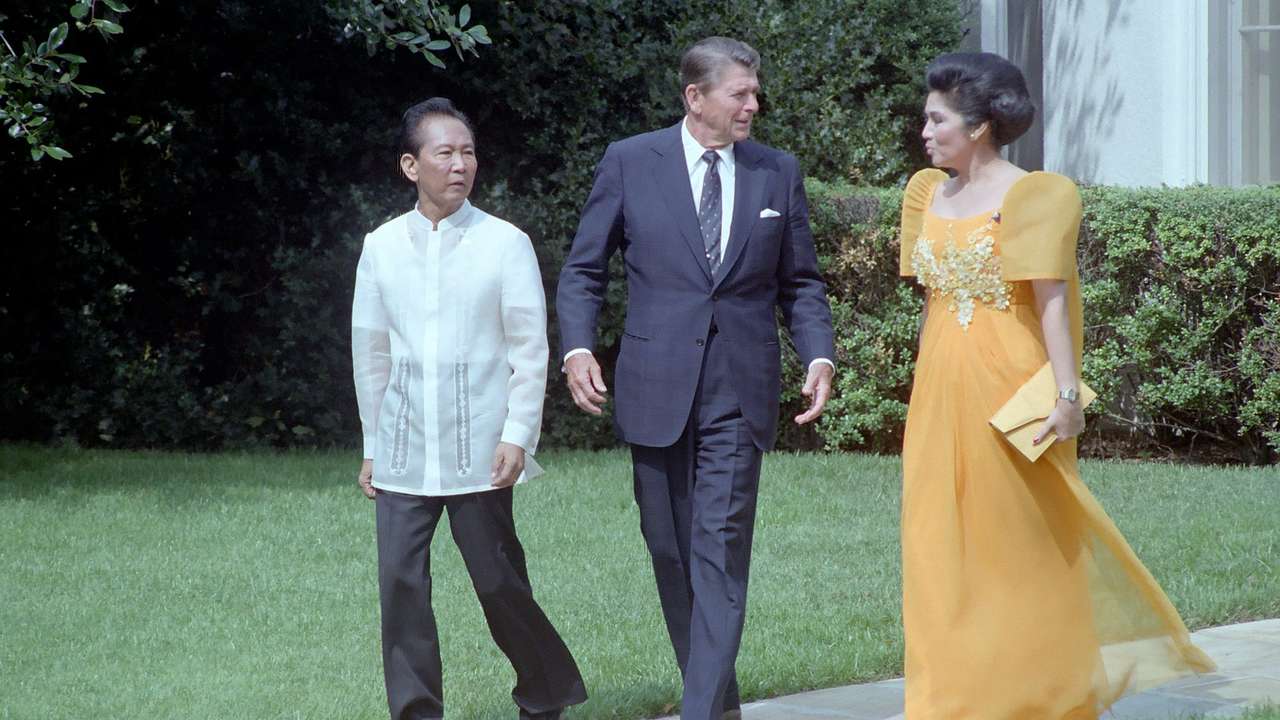
Ronald and Nancy Reagan were personal friends of Ferdinand Marcos Sr. and Imelda Marcos, then president and first lady, whose names are inseparable from what Filipinos describe as a “conjugal dictatorship” that ruled the country from 1965 until its downfall in 1986.
The parents of incumbent Philippine President Ferdinand Marcos Jr., Ferdinand Sr. and Imelda Marcos are believed to have plundered an estimated $10 billion from state coffers — a figure some now say may have grown to as much as $30 billion. As of 2020, only about $3 billion had been recovered.
Years of human rights abuses, corruption and media censorship gradually weakened the regime’s grip on power, particularly after the 1984 assassination of prominent opposition leader Benigno Aquino Jr., a killing widely linked to the Marcoses.
In 1986, a largely peaceful uprising — following years of unrest — toppled the Marcos regime. The family was flown into exile in Hawaii in an operation coordinated by the US under Reagan.
Ultimately, it was Filipinos themselves who overthrew the dictatorship.
The same cannot be said of Venezuela, where the 13-year rule of Maduro ended on Saturday following a US-led extraction. Several leaders in Southeast Asia, including Malaysian Prime Minister Anwar Ibrahim, argued that Venezuelans should have been allowed to determine their own political future.
Almost
Archival records show, however, that Washington came close to directly intervening to hasten Marcos’s removal. A January 1986 report by the New York Times, published a month before the EDSA People Power Revolution, noted that a consensus had already formed within the Reagan administration that Marcos’s exit was necessary to protect US interests.
“But the Administration has decided not to push Mr. Marcos from power by covert means, although that was considered by some officials, or by public attacks on him, although some officials have also come close to this,” the report said.
Reagan’s personal attachment to Marcos was believed to have influenced that restraint. According to one aide, the US president had long viewed Marcos as a “hero on a bubble-gum card he had collected as a kid.”
In January 1984, the US State Department recommended exerting economic pressure on Marcos to force reforms. Reagan agreed to limited pressure, but warned that abandoning Marcos entirely would risk confronting “a Communist power in the Pacific”.
“We’ve agreed that he should be told I’m recommending he step down & we’ll take the lead in negotiating his safety & offering him sanctuary in the U.S.,” Reagan wrote in his diary, made available online by the Reagan Presidential Library and Museum in California.
Post-revolt
The EDSA uprising ushered in the presidency of Corazon Aquino, the widow of the slain opposition leader, who served as president until 1992. During her term, the Philippines adopted a new charter — the 1987 Constitution — which remains in force today.
Reagan even attempted to persuade Aquino to allow Marcos to remain in the Philippines.
“He says he wants to live out his life in the Philippines. Well we’ll try to negotiate that,” Reagan said at the time. When those efforts failed, he pledged protection for Marcos in exile: “We’re going to provide S[ecret] S[ervice] protection for a limited time. So—no civil war and we’ve proceeded to recognize the new Philippine govt.”
The Marcos family was allowed to return to the Philippines in 1991, a controversial decision by Aquino that enabled the once-deposed clan to rebuild its political fortunes — a process that culminated in 2022, when, 36 years after their ouster, a Marcos once again assumed the presidency.
For the US, Reagan was said to have been “pained” by the downfall of his longtime pals. His confidence in them eventually eroded as evidence of their corruption mounted. In October 1988, a federal grand jury in New York indicted Ferdinand and Imelda Marcos on charges of embezzling more than $100 million to purchase three Manhattan properties.
This story is written and edited by the Global South World team, you can contact us here.