Which beverages have the most caffeine?
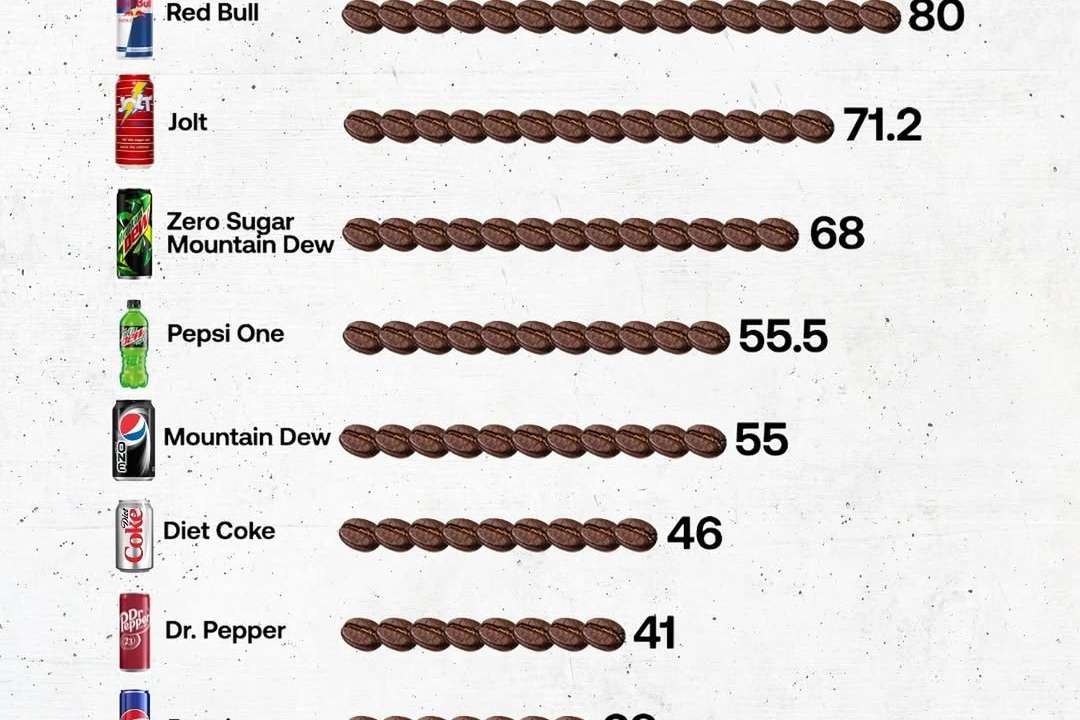
When it comes to your morning to-go or afternoon beverages, not all drinks are created equal. This article ranks popular energy drinks and sodas by the amount of caffeine they pack into a 12‑ounce (350ml) serving.
Energy drinks top the list
According to the Mathematics Department at the University of Utah, the energy drink Red Bull contains about 80 mg of caffeine in an 8.2‑ounce can. That may not sound like much compared with coffee (a typical 8‑ounce drip coffee ranges from 115 mg to 175mg), but it’s nearly four times the amount in a 12‑ounce can of Coca‑Cola. Another early energy drink, Jolt Cola, packs 71.2 mg of caffeine per 12 ounces, still formidable even decades after its launch.
One surprise on the graphic is Zero Sugar Mountain Dew, which has about 68 mg of caffeine per 12 oz, substantially more than the 55 mg found in regular Mountain Dew. PepsiCo, which makes Mountain Dew, markets the zero‑sugar version as having a bold flavour with an extra kick. Its caffeine content is closer to energy‑drink territory than to most sodas.
Sodas vary widely
Among traditional soft drinks, the caffeine count ranges from 55mg in Mountain Dew (and its Code Red and Diet versions) to 46mg in Diet Coke. Dr Pepper and Diet Dr Pepper both contain 41mg, while Pepsi‑Cola has 37.5mg. Coca‑Cola Classic, as well as its cherry, lemon and vanilla variants, delivers 34 mg of caffeine per 12‑ounce can.
At the lower end is Barq’s Root Beer with 23mg; diet root beers from Barq’s and other brands are caffeine-free.
These differences matter if you routinely reach for multiple cans a day. The U.S. Food and Drug Administration (FDA) notes that most adults can safely consume up to 400mg of caffeine per day. However, the FDA warns that children and adolescents should avoid energy drinks and other high‑caffeine beverages because they can cause increased heart rate, high blood pressure and sleep disturbances.
The Centre for Science in the Public Interest (CSPI) adds that the FDA doesn’t require companies to list caffeine content on labels and has compiled a caffeine chart with data for more than 200 products. In that chart, caffeinated soft drinks typically range from 23mg to 83mg per 12‑ounce serving, so the drinks in the World Visualized graphic span much of the spectrum.