Why a ‘black’ image of Jesus draws millions in the Philippines each year
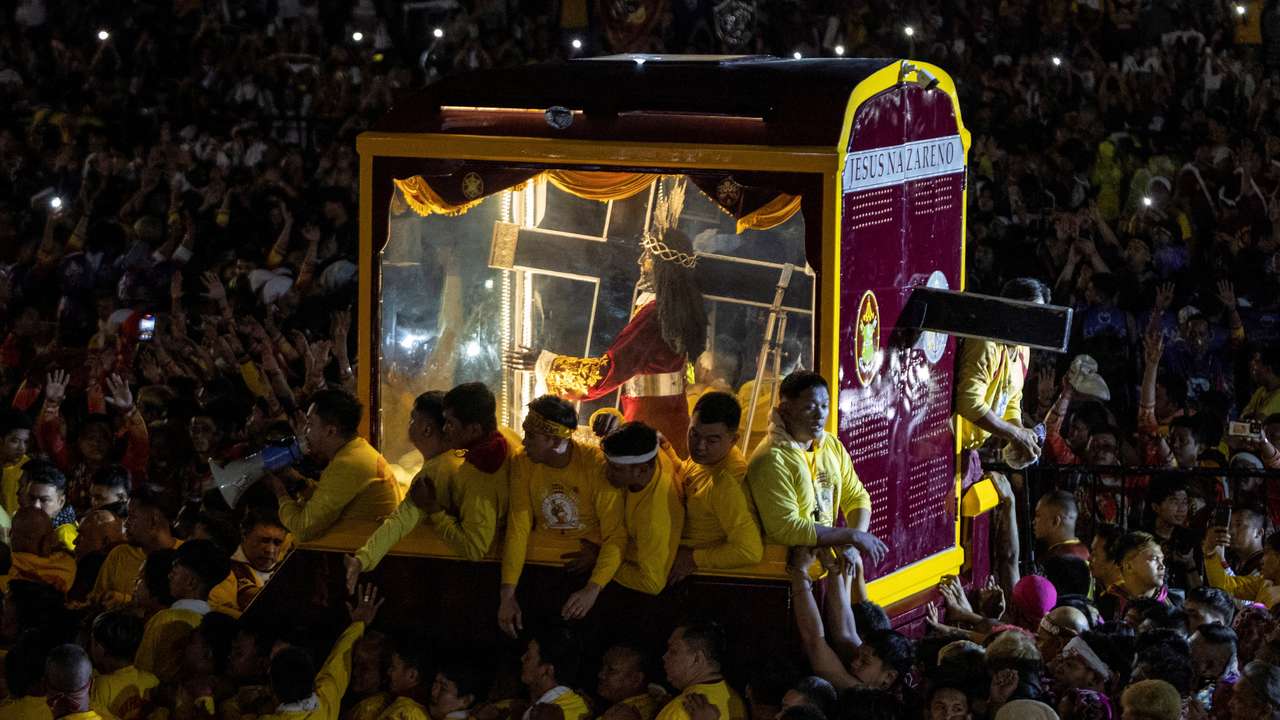
Every January 9, millions of Filipinos flood the streets of Manila for the Feast of the Jesus Nazareno, one of the world’s largest — and most fervent — Catholic gatherings.
At its centre is a centuries-old, dark-skinned image of Christ carrying the cross. The statue is placed on a carriage, known as the andas, and hauled through the streets by barefoot, maroon-clad devotees pulling thick ropes.
In reality, however, the sheer press of bodies — worshippers jostling to touch the image with their hands or wipe it with white towels — is often enough to propel the carriage along the nearly six-kilometre route, a journey that can take almost a full day.
As the Philippines marks the feast of the Jesus Nazareno, Global South World looks back at the image’s history and its rise into one of the country’s most enduring religious traditions, in a nation with the world’s third-largest Catholic population.
16th-century roots
Historical accounts trace the image’s arrival to 1606, when Spanish Augustinian Recollect missionaries brought it from Mexico to the Philippines. It was first housed in Bagumbayan, now Luneta Park, before being transferred to churches in Intramuros as devotion intensified.
By the mid-17th century, the cult of the Jesus Nazareno had gained official Vatican recognition. Pope Innocent X approved the formation of a religious brotherhood tasked with caring for the image.
The annual Traslación commemorates the transfer of the statue to its present home at Quiapo Church in central Manila, ordered between 1767 and 1787. What began as a modest procession steadily grew into a massive public event, particularly after the image was believed to have survived fires, earthquakes and wars — episodes devotees regard as miraculous.
A mammoth procession
In recent decades, the Traslación has evolved into a national spectacle. The procession retraces the historic route from Bagumbayan to Quiapo and can last nearly 24 hours.
In 2025, the Catholic Bishops’ Conference of the Philippines designated January 9 a nationwide liturgical feast, further elevating the event’s status.
Authorities expect around eight million people to take part this year. Many participate in the pahalik, a ritual veneration of the image, or attempt to touch it during the procession, believing it brings healing and blessings.
Why the Church dropped the word ‘black’
The Traslación has changed in recent years, particularly after the Covid-19 pandemic. The image is now carried in a glass-enclosed carriage to prevent damage to the centuries-old statue and reduce the risk of injury to devotees.
A more symbolic shift came in 2024, when Quiapo Church dropped the word “black” from its official title.
In a decree, Manila Archbishop Jose Cardinal Advincula announced the church would formally be known as the Minor Basilica and National Shrine of Jesus Nazareno – Saint John the Baptist Parish.
The move, the decree said, was intended “to further focus the people on the holy name of our Lord rather than a colour or attribute.”
As a national shrine, the Church said it aimed to be “more inclusive,” recognising devotions to other images of the cross-bearing Christ that are not dark in colour.
Despite these changes, the meaning of the image and the procession remains largely unchanged for Filipino devotees.
For many, the Jesus Nazareno represents a suffering Christ who identifies with hardship and endurance — a powerful symbol that, more than four centuries on, continues to shape religious life and identity in the Philippines.
This story is written and edited by the Global South World team, you can contact us here.