The cost of flying in West Africa is about to plummet
World Reframed episode 25 looks back at 2025 from the perspective of the Economic Community of West African States.
Three countries have walked away. A single currency promised for more than two decades still does not exist. Military coups keep returning, sanctions keep failing, and yet nearly 450 million people remain tied to a single regional organisation.
This is the reality of the Economic Community of West African States, ECOWAS. In 2025, the bloc turned 50 years old. Instead of celebrating unity and progress, it faced its most serious crisis of relevance since its founding.
This moment of doubt comes at a time when West Africa needs regional coordination more than ever. Security threats are multiplying, trade remains fragmented, mobility is expensive, and democratic institutions are fragile. As ECOWAS enters its sixth decade, fundamental questions are being asked openly. Can it still enforce democratic norms? Does it still carry economic weight? And can it survive in its current form?
Paper tiger
On paper, ECOWAS is formidable. It brings together 15 member states, represents more than 440 million people, and has a combined GDP of roughly 600 billion US dollars. That makes it one of the largest regional blocs in the Global South.
RECOMMENDED FOR YOU
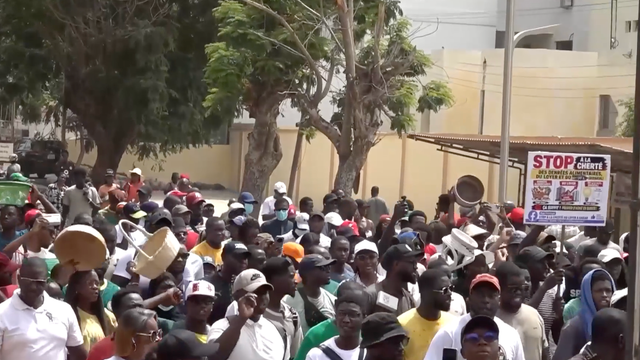
Senegalese protest rising cost of living in Dakar
In practice, integration remains shallow. Trade between ECOWAS countries still accounts for less than 20 percent of their total trade. In more integrated regions such as the European Union, internal trade exceeds 60 percent. The comparison highlights a central weakness. ECOWAS has scale, but it lacks cohesion.
That weakness became impossible to ignore in 2025, when Mali, Burkina Faso, and Niger formally withdrew from the bloc. Together, these Sahelian states represent around 70 million people and nearly 17 percent of ECOWAS landmass. While they contribute less than 5 percent of total GDP, their strategic and security importance is enormous.
Their departure followed years of tension after military coups, sanctions, and repeated threats of intervention. When ECOWAS failed to act militarily after the coup in Niger, it exposed a hard truth. The bloc did not have the political consensus or operational capacity to enforce its strongest decisions.
Empty threats
The crisis of democratic enforcement did not stop there. Later in the year, disputed elections in Guinea-Bissau once again demonstrated how fragile political institutions remain in the region. The military intervened, and ECOWAS responded with condemnation, suspension, and the threat of sanctions.
This has become a familiar pattern. Since 2020, sanctions alone have rarely reversed coups. More often, they have hardened military rule and eroded ECOWAS authority. Each repetition weakens the credibility of the bloc’s commitment to democracy.
The elusive Eco
Economically, ECOWAS continues to pursue one of its oldest ambitions: a single currency. The Eco was first proposed more than 20 years ago and is now tentatively scheduled for 2027 after missing multiple deadlines.
The obstacles are structural. Nigeria alone accounts for more than 60 percent of ECOWAS GDP, while many smaller economies struggle with inflation, debt distress, and fiscal instability. Without real convergence on economic fundamentals, the Eco remains a symbolic project rather than a functional one.
These challenges are made more acute by a fragmenting global economy and shrinking foreign assistance from traditional partners in Europe and the United States. Regional self-reliance is becoming more important just as ECOWAS capacity is being questioned.
RECOMMENDED FOR YOU
Brazil Roundup: Lula gains an election edge, judicial scrutiny intensifies, ports expose a growth bottleneck
Tax-free flying
Yet amid the uncertainty, there is a reason for cautious optimism as 2026 begins.
From January, air travel across ECOWAS member states is set to become tax-free, with sharp reductions in passenger and security charges. This is one of the bloc’s most tangible policy wins in years.
The reform matters because West Africa has some of the highest intra-regional airfares in the world. It is often cheaper to fly to Europe than to a neighbouring country. If fully implemented, the changes could reduce fares by 20 to 40 percent, benefiting traders, students, tourists, and families while advancing free movement in a practical way.
Connectivity has long been neglected in African economic policy, despite its importance for growth. People want to travel, and people travelling drives commerce. Currently, international departure taxes in Africa average around $68 per trip, with West Africa the most expensive subregion. Short flights of just a few hundred kilometres can cost hundreds of dollars.
This reform requires coordination and execution more than large financial outlays. If governments create the right conditions, the private sector can step in. For ECOWAS, this could be a rare example of delivery matching ambition.
A chance for redemption
As 2025 ends, ECOWAS looks like this: large in population, fragmented in politics, slow in economic integration, weak in enforcing democracy, but still capable of delivering reforms that people can feel in their daily lives.
At 50, ECOWAS is no longer just a regional institution. It is a test case for whether African multilateralism can adapt to a changing political reality. The question now is whether the future of regional cooperation will be driven by declarations, or defined by delivery.
The answer will shape not just ECOWAS, but the credibility of regional integration across the Global South in the years ahead.
RECOMMENDED FOR YOU
Niger accuses France of backing failed coup attempt
Click here to watch our previous episodes
World Reframed is produced in London by Global South World, part of the Impactum Group. Its editors are Duncan Hooper and Ismail Akwei.
ISSN 2978-4891
This story is written and edited by the Global South World team, you can contact us here.
This story is written and edited by the Global South World team, you can contact us here.